The Best Fluffy Pancakes recipe you will fall in love with. Full of tips and tricks to help you make the best pancakes.

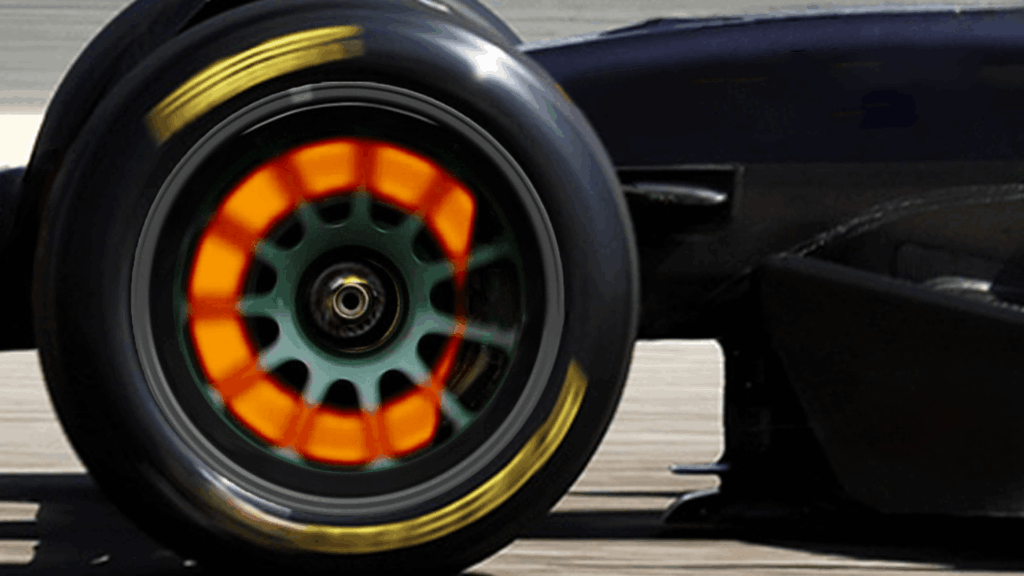
In a sport where every millisecond counts, Formula 1 engineers rely on carbon brakes not because they’re exotic, but because they deliver unmatched stopping power, fade resistance, and weight savings under the most extreme conditions in motorsport.
Why F1 Cars Use Carbon Brakes & How They Work
Introduction
For fans of Formula 1, race cars represent the pinnacle of automotive performance. Every component is optimized for speed, efficiency, and reliability — but few parts are as critical to performance and safety as the braking system. When an F1 car approaches a hairpin turn at almost 200 mph (320 km/h), it is not just the driver’s skill that keeps it on track, but also the remarkable technology in the brakes.
Unlike road cars, which typically use steel or iron brake discs, Formula 1 cars use carbon brakes. These are designed to handle intense heat, massive deceleration, and sustained performance over a Grand Prix distance. But what exactly are carbon brakes? Why are they used in F1? And how do they work?
In this article, we’ll explore:
- What carbon brakes are
- The science behind their design and performance
- How they operate in a Formula 1 car
- The advantages and limitations of carbon brakes
- How drivers and engineers manage braking performance on race day
Let’s dive in.
1. What Are Carbon Brakes?
Carbon brakes refer to brake discs and pads made from carbon fiber reinforced carbon (CFRC) — essentially carbon fiber material reinforced and baked in a special process to form a very strong, heat-resistant structure.
Core Components
- Carbon Brake Disc: A large ceramic-like carbon fiber disc mounted to the wheel hub.
- Carbon Brake Pads: Matched carbon fiber pads that clamp onto the disc when braking.
- Calipers: High-strength aluminum or titanium bodies that house pistons to squeeze pads against the disc.
- Hydraulic System: Fluid-filled system that transfers pedal pressure to the calipers.
Unlike steel brakes on road cars, carbon brakes are designed to work best at extremely high temperatures — typically between 400°C and 1000°C (752°F to 1832°F).
2. The Physics of Braking in F1
Kinetic Energy and Heat
When a car is traveling at high speed, it possesses enormous kinetic energy:Kinetic Energy=21mv2
- m = mass of the car
- v = velocity of the car
This energy must be dissipated to bring the car to a stop — and it turns into heat.
In a Formula 1 car, a huge amount of energy is dissipated in very short time spans. For example:
- At 300 km/h (186 mph), braking into a corner requires shedding enormous kinetic energy
- Brakes can reach over 1000°C in a few seconds
This is why high-temperature performance is critical.
3. Why F1 Uses Carbon Brakes
3.1. Weight Savings
Formula 1 cars must adhere to strict minimum weight limits, and every gram matters. Carbon brakes are much lighter than equivalent steel brakes.
Why weight matters:
- Lower weight improves acceleration, braking, and cornering
- Unsprung mass (weight not supported by suspension) directly affects handling
- Carbon brakes drastically reduce unsprung mass
3.2. Improved Heat Tolerance
Steel brakes can overheat and fade — meaning loss of braking power when too hot.
Carbon brakes:
- Perform better the hotter they get (to a point)
- Resist thermal degradation
- Avoid cracking or warping under intense heat
3.3. Better Performance at High Temperatures
Unlike steel brakes that work best cool, carbon brakes are engineered to operate at extremely high temperatures, making them ideal for repeated heavy braking zones.
3.4. Fade Resistance
Brake fade happens when the braking system loses effectiveness due to heat buildup. Carbon brakes maintain friction even at high temperature, so drivers can brake hard lap after lap.
3.5. Consistency Over Time
A key goal in F1 is predictability: carbon brakes offer consistent performance even after prolonged use, which is crucial during races that last over 300 km.
4. How Carbon Brakes Work
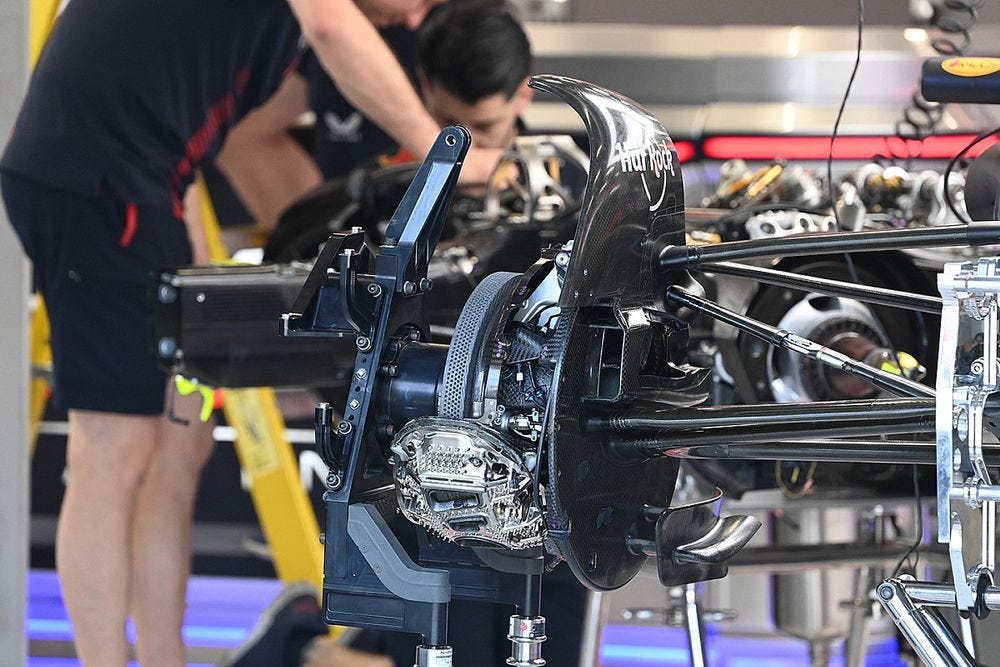
4.1. The Brake Disc
The F1 brake disc is made of carbon fiber reinforced carbon. This material can withstand incredible temperatures while retaining structural integrity.
Key characteristics:
- Extremely high thermal conductivity
- Very low thermal expansion — meaning it doesn’t deform easily under heat
- High durability under repeated heating and cooling cycles
4.2. The Brake Pad
The pad also uses specialized carbon compounds.
These are chosen for:
- Maximum friction
- Resistance to wear
- Ability to operate in high heat environments
- Smooth engagement with discs
Pads in F1 are carefully manufactured to exacting tolerances — tiny variations can affect performance.
4.3. Brake Calipers
Carbon brake calipers are usually made from lightweight aluminum or titanium alloys:
- They house pistons
- They convert hydraulic pressure into clamping force
- They must be rigid to avoid flex under load
4.4. Hydraulic System and Brake-By-Wire
Formula 1 uses advanced hydraulic systems and in some cases brake-by-wire technology.
In brake-by-wire:
- The rear brakes are controlled electronically
- The system adjusts braking balance dynamically
- Drivers can control rear braking force via software parameters
4.5. Cooling and Heat Management
Carbon brakes generate enormous heat. Managing that heat is critical.
Cooling systems include:
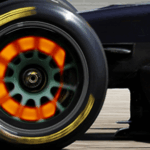
- Brake ducts: Channels that force air onto the brake disc and calipers
- Vanes inside the disc to circulate air
- Complex thermal barriers to protect suspension, tires, and cockpit
5. The Temperature Sweet Spot
Carbon brakes need to be hot to work well.
- Below ~400°C they have less friction
- At race conditions, discs can exceed 1000°C
- Drivers warm up brakes during formation lap
This is very different from road cars, where brakes perform best when cool.
6. Braking Performance Metrics
When an F1 car slows from high speed:
- Deceleration can exceed 5g
- Drivers pull up to 200 kg of force on the brake pedal
- Braking distances may be as short as 100 meters from high-speed corners
These numbers require brakes that can withstand massive forces and heat.
7. Carbon vs. Steel Brakes
| Feature | Carbon Brakes | Steel Brakes |
|---|---|---|
| Optimal Temperature | Very High | Low–Moderate |
| Weight | Very Light | Heavy |
| Fade Resistance | Excellent | Moderate |
| Cost | Extremely High | Affordable |
| Longevity | Race-specific | Road-friendly |
Steel brakes are great for everyday cars — but under F1 conditions, they would quickly overheat and fail.
8. Limitations and Challenges
Carbon brakes are amazing — but not perfect.
8.1. Cost
They are very expensive:
- Manufacturing involves exotic materials and precision processes
- Teams invest hundreds of thousands of dollars per set
8.2. Warm-Up Requirement
Carbon brakes must reach high temperature to perform — meaning:
- Drivers must “prep” brakes before heavy braking
- Cold braking zones early in races can be tricky
8.3. Specialized Handling
Carbon brakes behave differently depending on:
- Temperature
- Track surface
- Driver technique
Teams spend hours adjusting brake bias and curves to suit each circuit.
9. How Drivers Manage Brakes
Drivers use several techniques:
9.1. Brake Warm-Up
During out-laps and formation laps, drivers:
- Pump brakes
- Feather brake pedal to generate heat
- Avoid locking wheels
This helps bring brakes into the optimal temperature range.
9.2. Brake Bias Adjustment
Drivers can adjust front-to-rear brake bias:
- To balance stability
- To prevent rear locking
- To suit different track conditions
9.3. Brake Cooling Management
Too much cooling can make brakes too cold — teams monitor temperature and adjust duct settings accordingly.
10. Brake Ducts and Aerodynamics
In F1, everything affects aerodynamics — including brakes.
10.1. Brake Duct Design
Brake ducts are shaped to:
- Channel air efficiently
- Minimize drag
- Maximize cooling
These ducts are often developed specifically for each circuit’s demands.
10.2. Balancing Cooling & Drag
- Too much airflow = excessive drag
- Too little airflow = overheating
Teams use computational fluid dynamics (CFD) and wind tunnel data to find the sweet spot.
11. Carbon Brakes in Rule Books
F1 regulations dictate:
- Material standards
- Safety requirements
- Testing procedures
Teams must conform — but within those rules, innovation continues.
12. Real-World Examples
Consider famous circuits:
- Monza: Low downforce — heavy braking into tight chicanes
- Spa-Francorchamps: Long high-speed sectors and hard braking zones from high speed
- Suzuka: Multiple heavy braking zones
Each demands different brake strategies — but all rely on carbon technology for peak performance.
13. Future of Braking Technology in F1
While carbon brakes are standard today, future innovations could include:
- Smarter brake-by-wire systems
- New carbon composite formulations
- Integrated heat energy recovery
As battery and hybrid technology grow, brake systems may evolve to integrate energy management too.
Final Thoughts
Unlike steel brakes used on street cars, carbon brakes are designed to operate at temperatures exceeding 400°C and often surpass 1000°C — where their friction and performance peak. Their design, materials, and management systems are fine-tuned for the demanding environment of F1 racing, where every fraction of a second matters.
Though costly and complex, carbon brakes deliver the performance that makes modern Formula 1 braking one of the most impressive and scrutinized systems in motorsport engineering.
Steel brakes cannot withstand the extreme temperatures and repeated heavy braking seen in F1. They overheat and lose effectiveness (brake fade), whereas carbon brakes are designed to get hotter and maintain performance reliably.
Not always, but they are highly stressed parts. Teams inspect and often replace or re-machine brake discs and pads frequently, especially during heavy usage circuits. Their life span is much shorter than road brakes due to high thermal stress.
Description for this block. Use this space for describing your block. Any text will do. Description for this block. You can use this space for describing your block.
Yes — many professional racing series (such as endurance racing, Le Mans Prototypes, IndyCar, and MotoGP) use carbon-based brake systems, though specifics vary depending on rules and track demands.