The Best Fluffy Pancakes recipe you will fall in love with. Full of tips and tricks to help you make the best pancakes.

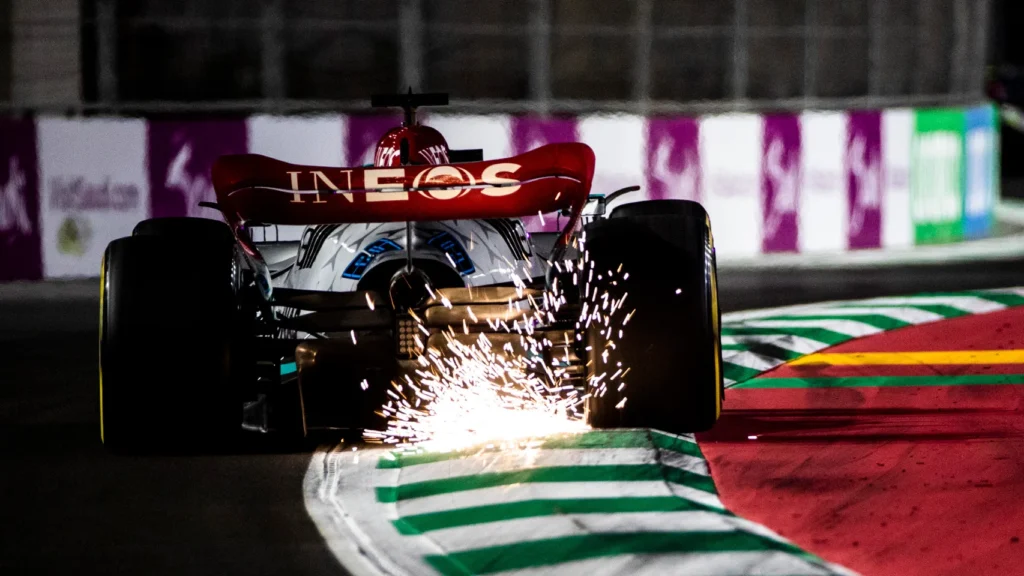
Porpoising is one of the most discussed technical phenomena in modern Formula 1, particularly since the introduction of ground-effect regulations. While the term may sound unusual, its consequences are serious — affecting performance, driver safety, car setup philosophy, and even FIA regulations.
This in-depth guide explains what porpoising is in Formula 1, why it happens, why it became such a major issue, and how teams work to control it. Whether you are new to F1 or curious about the engineering behind today’s cars, this article breaks the topic down in a clear and structured way.
What Is Porpoising in Formula 1?
Porpoising is a violent vertical oscillation where a Formula 1 car repeatedly bounces up and down at high speed, most often on long straights. The motion resembles a porpoise diving in and out of water, which is how the phenomenon got its name.
From an aerodynamic perspective, porpoising occurs when airflow under the car repeatedly stalls and reattaches. Each time downforce is lost, the car rises; when downforce returns, the car is pulled back down. This creates a continuous bouncing cycle that can happen many times per second.
Key characteristics of porpoising include:
- Rapid vertical bouncing at high speed
- Sudden loss and regain of downforce
- Most visible on long straights
- Closely linked to ground-effect aerodynamics
Although some bouncing existed in earlier eras of Formula 1, modern porpoising became extreme only after the reintroduction of ground-effect floors.
Why Did Porpoising Become a Major Issue in Modern Formula 1?
The resurgence of porpoising is directly tied to the 2022 Formula 1 technical regulations. These rules were designed to improve racing by allowing cars to follow each other more closely, reducing turbulent airflow from wings and shifting downforce generation to the floor.
By relying heavily on underfloor tunnels, modern F1 cars produce enormous amounts of downforce — but only within a very narrow operating window. Once airflow becomes unstable, the car’s behavior changes instantly and dramatically.
Several factors contributed to porpoising becoming a widespread issue:
- Reintroduction of ground-effect tunnels
- Aggressive ride height targets
- Limited testing data under new regulations
- Teams pushing aerodynamic limits early in the regulation cycle
As teams chased performance, porpoising quickly emerged as one of the defining challenges of the new era.
How Porpoising Happens (Step-by-Step Explanation)
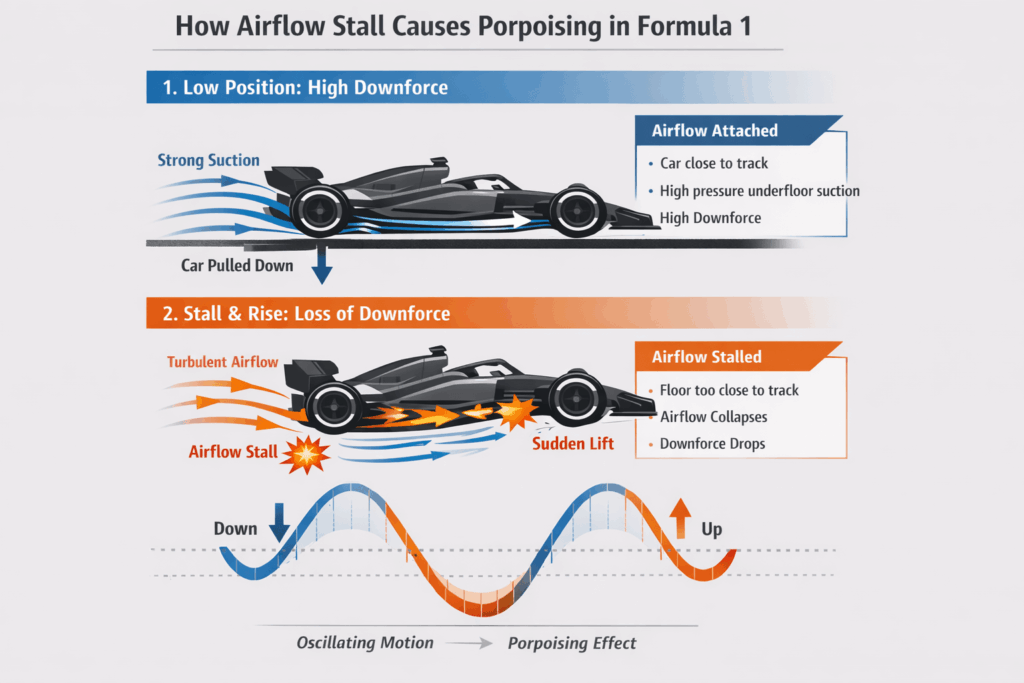
Porpoising is caused by a self-reinforcing aerodynamic feedback loop between ride height and airflow.
As speed increases, the air flowing under the car accelerates, creating suction that pulls the car closer to the track. When the gap between the floor and the ground becomes too small, airflow stalls suddenly, causing an abrupt loss of downforce.
The full cycle typically follows this sequence:
- The car runs very low to the ground to maximize downforce
- Air accelerates through the underfloor tunnels
- Increased suction pulls the car downward
- The floor gets too close to the track
- Airflow under the floor stalls
- Downforce drops sharply
- The car rises rapidly
- Airflow reattaches under the floor
- Downforce returns and pulls the car back down
- The cycle repeats at high frequency
Once initiated, porpoising will continue until speed is reduced or aerodynamic conditions change.
Main Causes of Porpoising in Formula 1
Ground-Effect Aerodynamics
Modern Formula 1 cars generate most of their downforce from the floor rather than the wings. While this approach is highly efficient, it is also extremely sensitive to ride height.
Ground-effect airflow behaves differently from wing-generated downforce. Instead of gradually losing efficiency, it can fail suddenly once airflow conditions fall outside a narrow window.
Key ground-effect factors include:
- Heavy reliance on underfloor tunnels
- Sudden airflow stall characteristics
- Narrow ride height operating range
- High sensitivity to track surface changes
Extremely Low Ride Height
To maximize performance, teams push ride height as low as possible. A lower car produces more suction and reduces drag, leading to faster lap times.
However, this leaves very little margin for error. Even small bumps or kerb strikes can trigger airflow instability and initiate porpoising.
Reasons teams run such low ride heights include:
- Increased underfloor downforce
- Reduced aerodynamic drag
- Improved straight-line speed
- Competitive pressure to maximize performance
Stiff Suspension Setups
Ground-effect cars require stiff suspension to maintain a consistent aerodynamic platform. While this improves airflow stability under ideal conditions, it reduces the suspension’s ability to absorb vertical movement.
Once porpoising begins, stiff suspension makes the oscillations harsher and more difficult to control.
Effects of stiff suspension include:
- Limited vertical compliance
- Reduced damping of oscillations
- Increased load transfer to the driver
- Higher physical strain
Track Characteristics That Worsen Porpoising
Porpoising is not equally severe at all circuits. Certain track characteristics make the problem much worse.
Porpoising is most pronounced on circuits with:
- Long, high-speed straights
- Bumpy or uneven surfaces
- Heavy braking zones following straights
Notable examples include:
- Baku City Circuit
- Spa-Francorchamps
- Monza
- Jeddah Corniche Circuit
Why Is Porpoising a Serious Problem?
Driver Safety and Physical Impact
Severe porpoising can cause significant physical discomfort for drivers. Repeated vertical impacts place stress on the neck, spine, and core muscles, especially at high speed.
Several drivers have publicly spoken about pain and discomfort caused by porpoising, raising concerns about long-term health effects.
Reported driver issues include:
- Neck and spinal strain
- Headaches and fatigue
- Reduced vision clarity under braking
- Difficulty maintaining concentration
Performance and Car Control Issues
While running low improves downforce, excessive porpoising ultimately reduces performance. An unstable car is harder to control, harder to brake, and more unpredictable in corners.
Performance impacts include:
- Inconsistent braking stability
- Reduced top speed efficiency
- Poor tire management
- Unpredictable corner entry behavior
- Compromised race pace consistency
Setup and Strategy Limitations
Porpoising restricts setup flexibility. Teams may be forced to compromise qualifying performance in favor of race stability, affecting overall strategy.
Setup compromises often include:
- Raising ride height
- Reducing downforce levels
- Altering suspension stiffness
- Accepting slower lap times
How Do Formula 1 Teams Fix Porpoising?
Raising the Ride Height
The most straightforward solution is to raise the car. Increasing ride height reduces airflow stall and stabilizes the underfloor.
However, this comes at the cost of downforce and lap time, making it an undesirable but sometimes necessary compromise.
Effects of raising ride height:
- Reduced porpoising severity
- Improved driver comfort
- Lower overall downforce
- Slower lap times
Floor and Aerodynamic Design Changes
Teams invest heavily in refining floor design to stabilize airflow across a wider ride height range. These changes aim to reduce sensitivity to airflow stall.
Common aerodynamic updates include:
- Increased floor stiffness
- Revised floor edge geometry
- Improved diffuser airflow management
- Better sealing of underfloor airflow
Suspension and Mechanical Adjustments
Suspension tuning plays a crucial role in controlling porpoising. Engineers adjust damping, springs, and third-element suspension systems to reduce vertical oscillations.
Typical mechanical changes include:
- Revised heave spring settings
- Softer damping characteristics
- Modified third-element suspension behavior
FIA Technical Directives
The FIA introduced technical measures to limit extreme porpoising without banning innovation. These directives focused on safety rather than performance restriction.
FIA actions included:
- Increased scrutiny of extreme setups
- Minimum floor stiffness tests
- Vertical oscillation monitoring
- Ride height enforcement
Final Thoughts
Porpoising is a clear example of how extreme performance in Formula 1 comes with complex engineering challenges. It highlights the delicate balance between aerodynamics, mechanical design, safety, and driver comfort.
Understanding porpoising gives fans deeper insight into why modern Formula 1 cars behave the way they do — and why teams are constantly searching for the perfect compromise between speed and stability.
Porpoising has been significantly reduced, but it has not been completely eliminated. Teams now better understand ground-effect behavior and design cars with wider operating windows. However, aggressive setups, new aerodynamic upgrades, or specific track conditions can still reintroduce bouncing.
Porpoising and bottoming out are often confused, but they are fundamentally different issues. Porpoising is aerodynamic in nature, while bottoming out is mechanical contact between the car and the track.
Key differences:
- Porpoising involves airflow stall and recovery
- Bottoming out involves physical contact with the track
- Porpoising can occur without sparks
- Bottoming out can occur without porpoising
The two can occur together, but they are not the same phenomenon.
Severe porpoising can cause physical discomfort, neck strain, and reduced car control. While not usually dangerous at today’s levels, extreme cases raised safety concerns and prompted FIA intervention.