The Best Fluffy Pancakes recipe you will fall in love with. Full of tips and tricks to help you make the best pancakes.

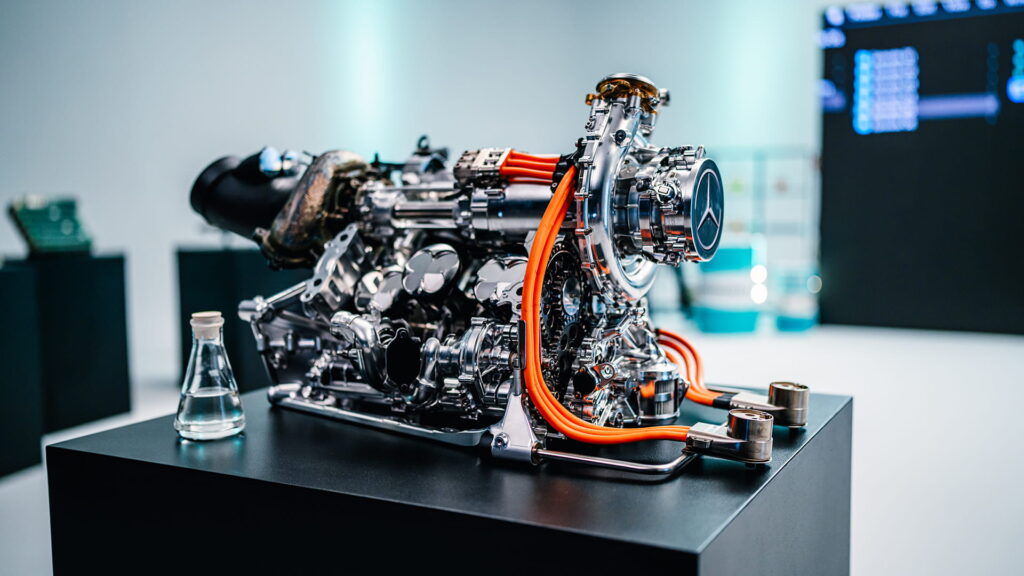
A Formula 1 power unit is far more advanced than a traditional racing engine. Modern F1 cars use a highly complex hybrid system combining a turbocharged internal combustion engine with multiple electric motor generators and a sophisticated energy store. Together, these components deliver incredible efficiency, extreme power, and cutting-edge technology that makes F1 the pinnacle of automotive engineering.
Introduction: Why F1 Says “Power Unit” Instead of Engine
If you are new to Formula 1, you may wonder why commentators, teams, and journalists rarely use the word engine anymore. Instead, they constantly refer to the power unit.
That change happened in 2014, when the sport entered the hybrid era. Since then, the system that propels the car has become far more than a fuel-burning engine. It is now a combination of combustion technology, energy recovery, electric boost, and computer management.
Calling it simply an engine would ignore most of what actually produces performance.
In modern F1, the power unit is designed to:
- Deliver maximum horsepower
- Recover wasted energy
- Improve fuel efficiency
- Provide strategic deployment options
- Meet strict FIA regulations
- Survive multiple race weekends
It is one of the most expensive and technologically impressive parts of the entire car.
The Philosophy Behind the Modern F1 Power Unit
Formula 1 wants to remain relevant to the road-car industry. Manufacturers like Mercedes, Ferrari, Renault, and Honda use the sport as a laboratory for future automotive innovation.
That is why hybrid efficiency is now just as important as raw speed.
The current power unit concept aims to:
- Extract more energy from less fuel
- Recycle heat and braking forces
- Increase thermal efficiency
- Develop hybrid expertise
- Push battery and motor technology
In fact, modern F1 engines can exceed 50% thermal efficiency, an astonishing number compared to most road cars.
Main Components of an F1 Power Unit
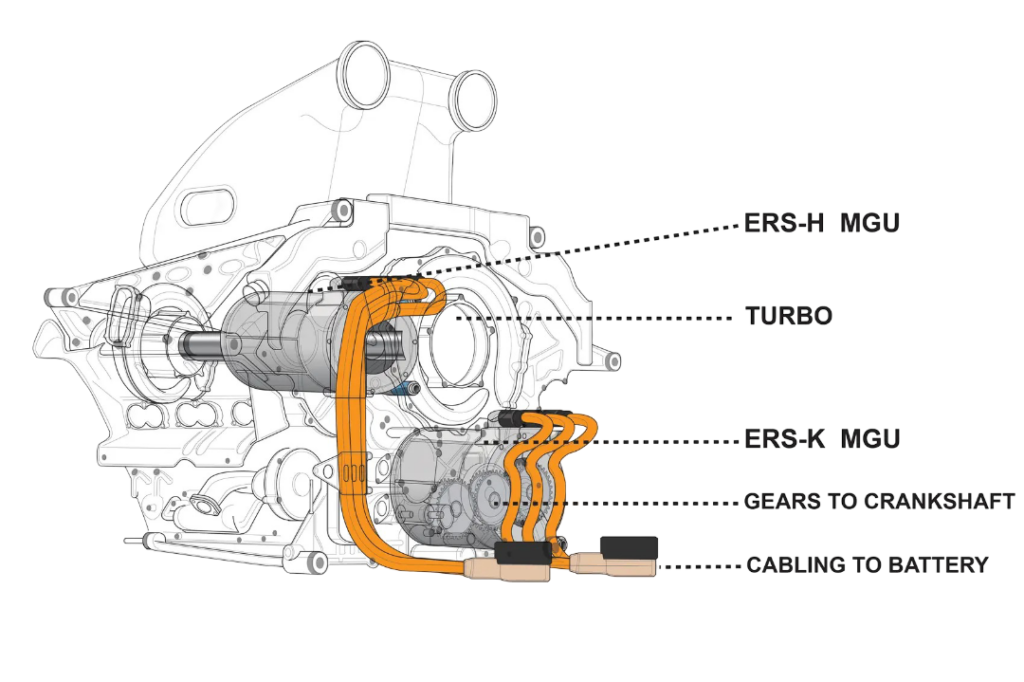
A modern F1 power unit is made of six primary elements working together as one integrated system.
They include:
- Internal Combustion Engine (ICE)
- Turbocharger
- MGU-K (Motor Generator Unit – Kinetic)
- MGU-H (Motor Generator Unit – Heat)
- Energy Store (battery)
- Control Electronics
Each has a precise role in producing and managing performance.
Let’s break them down.
Internal Combustion Engine (ICE)
At the heart of the power unit sits the traditional engine.
Today, Formula 1 uses a 1.6-liter V6 turbocharged engine limited by strict fuel flow rules. Despite the small size, it produces enormous power thanks to extreme engineering precision and very high rotational speeds.
The ICE remains the foundation of propulsion, but it is no longer the only source.
Key characteristics include:
- Six cylinders arranged in a V shape
- Turbocharged for greater air intake
- Limited fuel flow rate
- Around 15,000 rpm maximum
- Designed for reliability across several races
Without hybrid assistance, the car would be far slower.
Turbocharger: Turning Exhaust Into Power
The turbocharger increases engine performance by forcing more air into the combustion chamber. More air means more fuel can be burned efficiently, which means more power.
Instead of wasting exhaust gases, the turbo uses them to spin a turbine connected to a compressor.
This system allows a small engine to behave like a much larger one.
Its main benefits:
- Higher power output
- Better fuel efficiency
- Improved combustion
- Smaller engine size
However, turbochargers traditionally suffer from turbo lag, which is where electric systems come into play.
MGU-K: Energy From Braking
The MGU-K is connected to the crankshaft. When the driver brakes, kinetic energy that would normally disappear as heat is captured and converted into electricity.
This energy is then stored in the battery and later redeployed as extra power.
Think of it like an advanced hybrid road car system — but massively more powerful.
The MGU-K can:
- Recover energy under braking
- Provide additional horsepower
- Help acceleration
- Reduce fuel consumption
- Operate within FIA energy limits
At full deployment, it can add around 120 kW (about 160 hp).
MGU-H: Energy From Heat
The MGU-H is one of the most fascinating and complex devices in Formula 1.
It is connected to the turbocharger and recovers energy from exhaust heat. It can also control turbo speed, virtually eliminating lag.
Unlike the MGU-K, it can send energy either to the battery or directly to the engine.
Its functions include:
- Converting heat into electrical power
- Keeping the turbo spinning
- Reducing throttle delay
- Improving efficiency
- Supporting continuous boost
It represents some of the most advanced energy technology in global motorsport.
Energy Store (Battery)
All recovered electrical energy needs somewhere to live.
That is the job of the energy store — essentially a high-performance battery pack capable of extremely rapid charge and discharge cycles.
These are far more advanced than consumer EV batteries.
They must be:
- Lightweight
- Powerful
- Reliable
- Extremely fast in response
- Able to survive high temperatures
Energy management becomes a strategic tool during races.
Control Electronics: The Brain of the System
The control electronics decide how and when energy is deployed or harvested.
This includes complex software, sensors, and mapping strategies.
They manage:
- Energy flow
- Safety limits
- Driver inputs
- Efficiency targets
- Deployment modes
Without this brain, the system would be chaotic.
How Much Power Does the Whole Unit Produce?
When all components work together, modern F1 power units produce around 950 to 1050 horsepower depending on conditions.
Power comes from two sources:
- Combustion engine
- Electric deployment
This blend allows incredible acceleration and top speed.
Why Energy Deployment Matters
Drivers cannot use electric boost freely at all times.
There are limits per lap and per race, meaning teams must choose carefully where to deploy extra power.
Deployment strategy affects:
- Overtaking
- Defending
- Qualifying laps
- Tire management
- Fuel saving
It becomes a chess match.
Reliability: Why Drivers Take Grid Penalties
Power units are limited in number per season. Exceeding the allocation leads to penalties.
This forces teams to balance:
- Performance
- Aggression
- Longevity
Too much stress can mean starting at the back.
How Drivers Interact With the Power Unit
Modern steering wheels allow drivers to adjust many settings.
They can change:
- Energy modes
- Battery use
- Differential behavior
- Fuel targets
- Regeneration levels
Driving is partly about managing resources.
Why These Systems Are Important for Road Cars
Hybrid innovations developed in F1 often influence production vehicles.
Areas impacted include:
- Energy recovery
- Battery efficiency
- Turbo technology
- Software management
- Thermal optimization
F1 acts as a research laboratory.
The Cost of a Power Unit
Although exact numbers are secret, estimates suggest a single power unit can cost millions of dollars.
This includes development, materials, and manufacturing.
They are masterpieces of precision engineering.
The Future: Changes Coming in 2026
Formula 1 is moving toward even more electrical power and sustainable fuels.
Upcoming directions include:
- Greater electric contribution
- Removal of MGU-H
- Simplified systems
- Sustainable combustion
- Cost control
The aim is modern relevance.
Why Understanding the Power Unit Helps You Enjoy Racing More
Once you understand what is happening under the bodywork, radio messages and strategies make more sense.
You start recognizing:
- Why drivers lift and coast
- Why battery charge matters
- Why overtakes succeed
- Why some tracks stress engines
- Why penalties happen
It transforms how you watch.
Final Thoughts
The modern Formula 1 power unit is a breathtaking combination of combustion science, hybrid innovation, and digital control. It represents the sport’s mission to balance speed with efficiency while pushing automotive technology forward. For new fans, learning how it works opens a new dimension of understanding and reveals why success in F1 depends as much on engineering brilliance as on driving talent.
An engine refers only to the combustion element, while the power unit includes the turbocharger, electric motor generators, battery, and control electronics that work together to produce performance.
Modern F1 cars typically produce close to 1,000 horsepower when combining the internal combustion engine and hybrid electrical systems.
They are designed to maximize efficiency, recover wasted energy, improve strategy options, and maintain relevance to future automotive technology.